
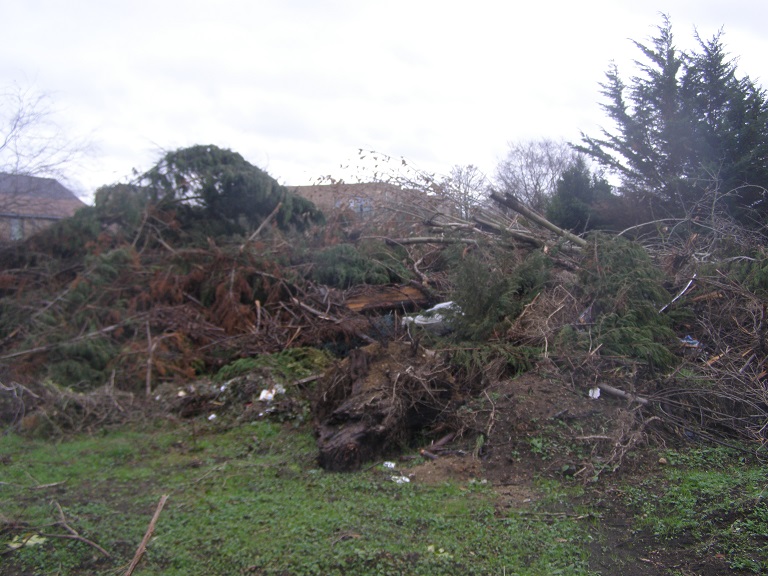
When Jennifer Sinclair of Ligna Consultancy visited the site of a proposed new development in the village of Trumpington on the outskirts of Cambridge to carry out an arboricultural impact survey she discovered most of the trees which once shaded three vegetable gardens reduced to stumps. No trace remained of the row mature Cypress trees described and photographed by Richard Dale when his company, Applied Ecology Ltd, carried out a preliminary ecological appraisal of the same site just a few months earlier. Presumably what was left of these trees made up the bulk of the broken branches piled up in the centre of the site.
In a perfect world companies such as Ligna Consultancy and Applied Ecology would be appointed by the planning department of the local authority. However, this is not a perfect world and neither Cambridge Council nor South Cambridge District Council, who share a planning department, have the resources to pay for, or supervise, environmental consultants and, instead, these are recruited by the landowners or property developers submitting plans. Control of these consultants, to the extent it does exist, is by way of a biodiversity gain target of 20%, which any proposed development should achieve and, in the case of Trumpington, is set by Greater Cambridgeshire Shared Planning (GCSP). The danger is landowners and developers lower the biodiversity baseline of a site before any surveys are carried out and plans submitted. It may also prove difficult for consultants competing for work in the construction industry to remain objective, especially if they have worked with the same developer on numerous projects. Too often the developer and the local authorities are being told what they want to hear. Although it is doubtful Hawkswren, the company employing Ligna Consultancy and Applied Ecology or planners at the GCSP, wanted to hear the assessed biodiversity ‘gain’ of the Trumpington development was minus 36%. Not that this would necessarily prove an impediment to getting the plans passed.
Trumpington, once a small village once separated from Cambridge by open countryside, has now been consumed by Great Kneighton and Trumpington Meadows, two estates of high-density housing, sometimes compared, unkindly, to housing complexes in cold war East Germany. A decent sized pot plant would increase the biodiversity these Corbusier style boxes by well over the required 20%. To achieve the required target for whole site however has proved more challenging and necessitated developers constructing faux parks and make-believe nature reserves. Hobson Green separates Great Kneighton from Cambridge University Hospital’s bio medical campus, and there is another open space between Trumpington Meadows and the river Cam. These two parks also satisfy the government’s current aspiration of ensuring everyone in England is within 15 minutes of a green space and water. Unfortunately it now appears the GCSP’s biodiversity target has fallen victim to Cambridge’s seemingly unrelenting growth.
Stephen Kelly, joint director of planning and economic development at GCSP, in a Kwasi Kwarteng challenge to orthodoxy, is claiming Cambridge will grow much faster than even central government figures suggest. He sees the need to increase the house building target for the region to over 50,000. Unfortunately, Cambridgeshire’s infrastructure is starting to creak. Plans submitted by developers have included new schools, new roads and, in one case, the relocation of a railway station. However, once these plans are passed and work begins, reality dawns and builders, pleading poverty, inform the GCSP the promised infrastructure is unaffordable and, if forced to provide it, they will simply down tools and Kelly’s houses will not get built. Consequently, South Cambridgeshire District and Cambridge City Councils find themselves having to pay for the infrastructure they believed they were getting for free out of their own funds. To remain solvent the councils need more houses and to attract young people to the area who, until they have children requiring schooling, are cash positive. A significant number of new houses around Trumpington have been built with the childless couple in mind. Anyone who has invested in a company which is buying revenue risks losing their money when the business hits the wall and Cambridge’s councils, are quite literally, running out of road. Hardly surprising then the 20% biodiversity gain target, which was only ever seen as a ‘nice to have’ rather than an essential, has become an anachronism, a relic of a bygone age of wooded glades, chalk streams and meadows.
Hobson Green itself is about to take a biodiversity hit as part of it disappears when Cambridge South station is built next to the hospital and biomedical campus. Anyone who believes the loss of green space when the station is built will be limited to a narrow sliver of land is deluding themselves. As well as linking the campus with Cambridge the new station will provide an alternative starting point for commuters travelling to London: one far more accessible than the existing one in the city itself. Eventually there will come pressure for an expanded car park at which point more of Hobson Green will be concreted over. GCSP concedes the new station will provide a net biodiversity loss but explains this will be offset by gains in other locations – although, for residents of Great Kneighton, not necessarily locations within 15 minutes of where they are live.
The idea that Hobson Green, as described in the glossy brochure produced when the plans for the development were submitted, would remain biodiverse once the houses in Great Kneighton were occupied was always ambitious. Cambridge council intends to clamp down on dog walkers using the park and, on the grounds of public safety, will limit to four the number of dogs a person can walk at any one time. Given it now seems people cannot walk in the park without the risk of being molested by dogs, what chance the ground nesting birds in the Hobson Park bird sanctuary can breed in peace. Trumpington Meadows’ own green space faces similar challenges to it biodiversity.
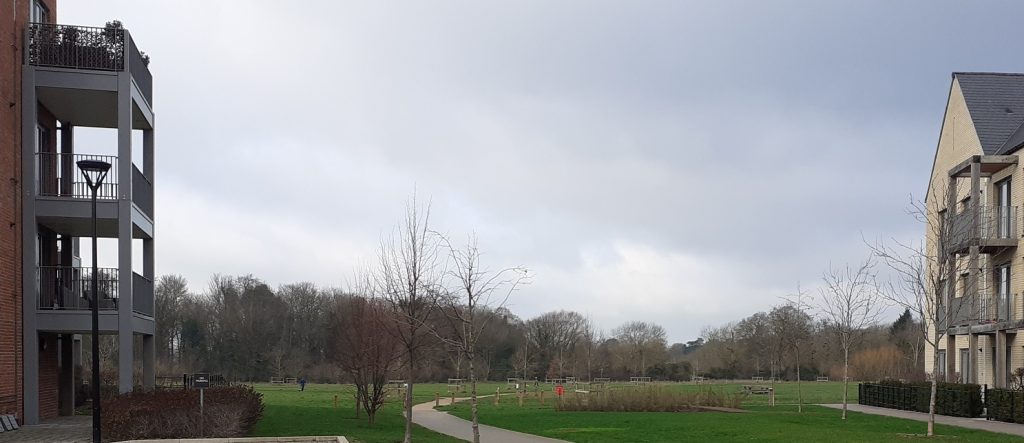
A joint venture funded by Barratt Homes and run by The Wildlife Trust the 148 acres of land, which the trust describes as a nature reserve and designed for people and wildlife – two things which traditionally tend not to mix, especially in such close proximity to hundreds of houses. When the Trumpington Meadows development was conceived part of its environmental credentials were the proposed green space and the estate’s connection to Cambridge railway station and the Biomedical campus via a guided busway. Parallel to the busway would be a pedestrian walkway and cycle path. Consequently, neither the developer or council planners saw a need for residents of Trumpington Meadows to own cars or the estate to include a large number of parking spaces.
Following the deaths of a cyclist and a pedestrian, the busway was closed in 2021. Since then residents of Trumpington Meadows have been forced to use a road-based bus service, a journey of 30 minutes not including the time spent waiting for a bus that is stuck in traffic on Trumpington’s congested roads. The alternative is to purchase a car, and many residents have: the commute is still 30-minutes but without time wasted stood at a bus stop in the rain. However, Trumpington Meadow’s was designed to be a ‘low car community’ with one car space per house and restricted on street parking: which worked, to a degree, when the guided busway was in operation.
Like Hobson Green, Trumpington Meadows’ green space suffers from overuse and is probably only still regarded as a nature reserve by the same people who pass off zoos as safari parks. It fails to match the description in either Barratt Homes’ marketing material, or the Wildlife Trust’s YouTube videos, and is predominantly the habitat of lesser threatened species such as Homo Sapiens and Canis Familiaris. Insect life battles light pollution, nesting birds prefer more secluded locations on the opposite bank of the river Cam and, apart from token patches of wildflowers, this is a meadow in name only with most of its fauna trampled into the earth. So, on the scale of things, does the loss a few Cypress trees and the concreting over of three gardens actually matter? Probably not.
From Stephen Kelly’s point view, what’s not to like about Hawkswren’s development in Trumpington. The eight houses squeezed into what was once the garden of a semidetached house on the edge of Great Kneighton, by an architect and developer experienced at filling the gaps left by the major housebuilders, are ideal for young, newly married ratepayers. And with Barratt Homes, Redrow and Persimmon, in anticipation of a downturn in the property market, reigning back of housing starts, developers such as Hawkswren are nearly all Kelly has left to meet his housing target. Houses which will be accessed by a narrow road, meandering so it passes as many of the existing houses as possible as well as a children’s play area and designed with minimal car usage in mind . It will have a pedestrian access leading out onto the busy four lane access road to Addenbrookes hospital and the biomedical campus, which residents will have to cross to access the guided busway (if the guided busway is operational). These problems can all be set aside, or overlooked, so surely a net biodiversity loss of 36% hardly matters and even if the development yielded a net gain, given the location, would that gain be sustainable.
While companies such as Ligna Consultancy and Applied Ecology visit sites before plans are submitted, they seldom, if ever, return once the development is complete and properties occupied. No-one, neither the consultants or the GCSP, mark the developer’s homework and, even if they did, how impartial would any assessment be? Even if the unlikely case that Hawkswren’s Trumpington development produced a net biodiversity gain of 20% this would quickly disappear once residents, needing somewhere to park cars, removed the trees and shrubs and paved wildflower seeded green spaces.
There is no such thing as a free lunch and it is obvious Cambridgeshire’s dash for growth, in the teeth of a recession, has a price and, for a council planning department under pressure, biodiversity targets seem to have become an expensive luxury.